Humans have probably attempted to depict motion as far back as the paleolithic period. While there were several predecessors, the 17th century invention of the magic lantern
provided the first apparatus with which convincing moving images have
been created. However, the movement of these images were the result of
moving parts rather than a rapid succession of sequential images. The
introduction of the
Phenakistoscope in 1833 marks the start of true animation, although it could only show loops of a limited number of "frames".
 Phenakistoscope.
The zeotrope
concept was suggested in 1834 by William George Horner, and from the
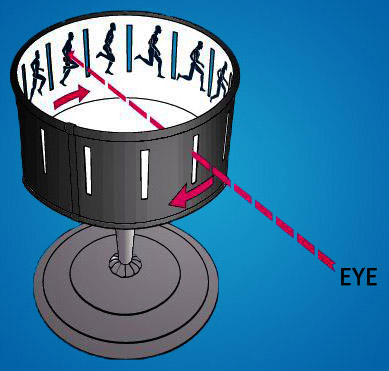
1860s marketed as the zoetrope. It operates on the same principle as the
phenakistoscope. It was a cylindrical spinning device with several
frames of animation printed on a paper strip placed around the interior
circumference.
The observer looks through vertical slits around the sides to view the
moving images on the opposite side as the cylinder spins.
Zeotrope.
The first known animated projection on a screen was created in France by Charles-Émile Reynaud, who was a French science teacher. Reynaud created the Praxinoscope in 1877 and the Théâtre Optique in December 1888. On 28 October 1892, he projected the first animation in public, Pauvre Pierrot, at the Musée Grévin in Paris.
This film is also notable as the first known instance of film
perforations being used. His films were not photographed, but drawn
directly onto the transparent strip. In 1900, more than 500,000 people
attended these screenings.
Praxinoscope.



Alex. Can you indicate where you describe the two animation techniques for criterion P4. You have rotoscoping somewhat described but there has to be at least two animation techniques specfically described to pass. You have mentioned several techniques, but not described how to do them.
ReplyDelete