 John Barnes Linnett patented the first flip book in 1868 as the kineograph. A flip book is a small book with relatively springy pages, each having
one in a series of animation images located near its unbound edge. The
user bends all of the pages back, normally with the thumb, then by a
gradual motion of the hand allows them to spring free one at a time. As
with the phenakistoscope, zoetrope and praxinoscope, the illusion of
motion is created by the apparent sudden replacement of each image by
the next in the series, but unlike those other inventions no
view-interrupting shutter or assembly of mirrors is required and no
viewing device other than the user's hand is absolutely necessary. Early
film animators cited flip books as their inspiration more often than
the earlier devices, which did not reach as wide an audience.
John Barnes Linnett patented the first flip book in 1868 as the kineograph. A flip book is a small book with relatively springy pages, each having
one in a series of animation images located near its unbound edge. The
user bends all of the pages back, normally with the thumb, then by a
gradual motion of the hand allows them to spring free one at a time. As
with the phenakistoscope, zoetrope and praxinoscope, the illusion of
motion is created by the apparent sudden replacement of each image by
the next in the series, but unlike those other inventions no
view-interrupting shutter or assembly of mirrors is required and no
viewing device other than the user's hand is absolutely necessary. Early
film animators cited flip books as their inspiration more often than
the earlier devices, which did not reach as wide an audience.THE SILENT ERA......
Charles-Émile Reynaud's Théâtre Optique is the earliest known example of projected animation. It predates even photographic motion picture devices such as Thomas Edison's 1893 invention, the kinetoscope, and the Lumière brother's 1894 invention, the cinematograph. Reynaud exhibited three of his animations on October 28, 1892 at Musée Grévin in Paris, France. The only surviving example of these three is Pauvre Pierrot, which was 500 frames long.
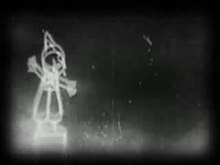
Émile Cohl's Fantasmagorie
After the cinematograph popularized the motion picture, producers began to explore the endless possibilities of animation in greater depth. A short stop-motion animation was produced in 1897 by Albert E. Smithand J. Stuart Blackton called The Humpty Dumpty Circus. Stop Motion is a technique in which real objects are moved around in the time between their images being recorded, so that when the images are viewed at a normal frame rate the objects appear to move by some invisible force. It directly descends from various early trick film techniques that created the illusion of impossible actions.
A few other films that featured stop motion technique were released afterward, but the first to receive wide scale appreciation was Blackton's The Haunted Hotel, which baffled viewers and inspired much further development. In 1906, Blackton also made the first drawn work of animation on standard film, Humorous Phases of Funny Faces. It features faces that are drawn on a chalkboard and then suddenly move autonomously.
Fantasmagorie, by the French director Émile Cohl (also called Émile Courtet), is also noteworthy. It was screened for the first time on August 17, 1908 at Théâtre du Gymnase in Paris. Cohl later went to Fort Lee, New Jerseynear New York City in 1912, where he worked for French studio Éclair and spread its animation technique to the US.
There is also a massive number of genres for animation:
- Absurdist/surreal/whimsical.
- Action.
- Adventure.
- Comedy.
- Crime.
- Drama.
- Fantasy.
- Historical.
For more info on these topics please go to:
https://en.wikipedia.org/wiki/List_of_genres
https://en.wikipedia.org/wiki/History_of_animation#The_silent_era
USAGE OF ANIMATION IN MEDIA SECTORS......
Animation is used in many sectors such as advertisement, movies and TV.
For example the advertisement for a car on TV, or a Disney movie your watching in the cinema are all parts of it being used in media sectors.
Here is a detailed table with examples:
ADVERTISING:
Adverts need to be attention grabbing, memorable and appealing, and animation is well suited to achieve this. Therefore, much of the work undertaken by the animation industry is in creating adverts that promote products or services for client companies. Although some animators are employed in-house by advertising agencies, experienced animators often work freelance, being contracted to work as and when required. Animated banners and sequences are commonplace on the internet, not only as adverts but also as a regular feature of website design.
ENTERTAINMENT:
Television carries an increasing number of animated programmes. For children, animation may be used for entertainment or to get an educational message across, while animated shows and short films aimed at older people may have dramatic, comedy or satirical themes.
Lately, with new digital technology, it has become easier to produce animate feature-length Films and DVDs/videos, and such films even have their own category at the Oscars!
One of the fastest-growing areas for animators is the field of commercial music video production. Videos can be completely animated or moving images can be used incorporating cartoon animation mixed with straight video footage of the band or artist.
TECHNIQUES USED IN ANIMATION....
Traditional animation involved animators drawing by hand for each and every frame. If you love the feel of pencils on a paper, then the traditional approach is very fascinating. Traditional animation is creating the drawings one by one on the frame. 2D animation involves creating numerous drawings then feeding into a plastic cells, hand painting them and create the animated sequence on a painted background image. This can be seen in early disney movies like Snow White and the Seven Dwarfs, Peter Pan, and Sleeping Beauty, Aladdin.
Audio-Animatronics and Autonomatronics:
Walt disneyimagineering created the trademark audio animatronics which is fitted in its disney theme parks. Otto is a robot which can easily sense a person in a room, converse with them and can also tell if they are happy. Autonomatronics technology is different from Audio-Animatronics technology. Audio-Animatronics technology repeats a pre-programmed show over and over again. Autonomatronics technology is driven by sophisticated cameras and sensors giving Otto the ability to make choices about what to say and do.
ROTOSCOPING:
Rotoscoping an animation technique used by animators to trace over motion picture footage, frame by frame, when realistic action is required. Originally, photographed live-action movie images were projected onto a glass panel and re-drawn by an animator. This projection equipment is referred to as a rotoscope.
Although this device was eventually replaced by computers, the process is still referred to as rotoscoping. In the visual effects industry, the term rotoscoping refers to the technique of manually creating a matte for an element on a live-action plate so it may be composited over another background. Rotoscoping has also been used to allow a special visual effect (such as a glow, for example) to be guided by the matte or rotoscoped line. One classic use of traditional rotoscoping was in the original three Star Wars movies, where it was used to create the glowing lightsaber effect, by creating a matte based on sticks held by the actors. To achieve this, effects technicians traced a line over each frame with the prop, then enlarged each line and added the glow.
Examples are: Aladdin, Alice in Wonderland, All Dogs Go to Heaven, Alois Nebel, American Pop, An American Tail, Anastasia, Beauty and The Beast, The Black Cauldron.
CRITICISM....
Criticism of animation has been common in media and cinema since its inception. With its popularity, a large amount of criticism has arisen, especially animated feature-length films. Many concerns of cultural representation, psychological effects on children have been brought up around the animation industry, which has remained rather politically unchanged and stagnant since its inception into mainstream culture.
Certain under-representation of women has been criticized in animation films and the industry.
Info link:
https://en.wikipedia.org/wiki/Animation#Criticism
ENTERTAINMENT:
Television carries an increasing number of animated programmes. For children, animation may be used for entertainment or to get an educational message across, while animated shows and short films aimed at older people may have dramatic, comedy or satirical themes.
Lately, with new digital technology, it has become easier to produce animate feature-length Films and DVDs/videos, and such films even have their own category at the Oscars!
One of the fastest-growing areas for animators is the field of commercial music video production. Videos can be completely animated or moving images can be used incorporating cartoon animation mixed with straight video footage of the band or artist.
TECHNIQUES USED IN ANIMATION....
Traditional animation involved animators drawing by hand for each and every frame. If you love the feel of pencils on a paper, then the traditional approach is very fascinating. Traditional animation is creating the drawings one by one on the frame. 2D animation involves creating numerous drawings then feeding into a plastic cells, hand painting them and create the animated sequence on a painted background image. This can be seen in early disney movies like Snow White and the Seven Dwarfs, Peter Pan, and Sleeping Beauty, Aladdin.
Audio-Animatronics and Autonomatronics:
Walt disneyimagineering created the trademark audio animatronics which is fitted in its disney theme parks. Otto is a robot which can easily sense a person in a room, converse with them and can also tell if they are happy. Autonomatronics technology is different from Audio-Animatronics technology. Audio-Animatronics technology repeats a pre-programmed show over and over again. Autonomatronics technology is driven by sophisticated cameras and sensors giving Otto the ability to make choices about what to say and do.
ROTOSCOPING:
Rotoscoping an animation technique used by animators to trace over motion picture footage, frame by frame, when realistic action is required. Originally, photographed live-action movie images were projected onto a glass panel and re-drawn by an animator. This projection equipment is referred to as a rotoscope.
Although this device was eventually replaced by computers, the process is still referred to as rotoscoping. In the visual effects industry, the term rotoscoping refers to the technique of manually creating a matte for an element on a live-action plate so it may be composited over another background. Rotoscoping has also been used to allow a special visual effect (such as a glow, for example) to be guided by the matte or rotoscoped line. One classic use of traditional rotoscoping was in the original three Star Wars movies, where it was used to create the glowing lightsaber effect, by creating a matte based on sticks held by the actors. To achieve this, effects technicians traced a line over each frame with the prop, then enlarged each line and added the glow.
Examples are: Aladdin, Alice in Wonderland, All Dogs Go to Heaven, Alois Nebel, American Pop, An American Tail, Anastasia, Beauty and The Beast, The Black Cauldron.
CRITICISM....
Criticism of animation has been common in media and cinema since its inception. With its popularity, a large amount of criticism has arisen, especially animated feature-length films. Many concerns of cultural representation, psychological effects on children have been brought up around the animation industry, which has remained rather politically unchanged and stagnant since its inception into mainstream culture.
Certain under-representation of women has been criticized in animation films and the industry.
Info link:
https://en.wikipedia.org/wiki/Animation#Criticism

No comments:
Post a Comment